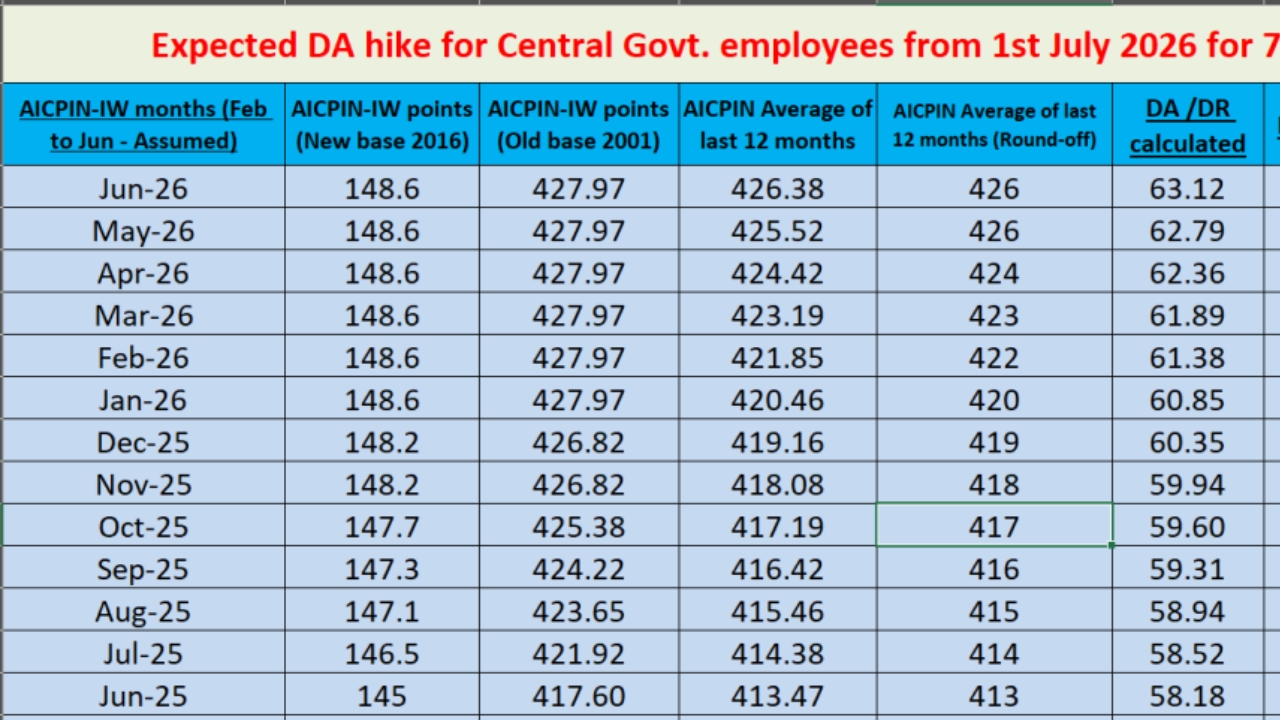
7th CPC DA Hike April 2026: The year 2026 has brought renewed expectations for central government employees and pensioners as discussions around the Dearness Allowance revision gain momentum. Under the framework of the 7th Central Pay Commission, periodic DA hikes are designed to help employees cope with rising inflation. The April 2026 revision is expected to bring a noticeable jump in both salaries and pensions, with some estimates suggesting salaries reaching ₹49,200 and pensions rising to ₹24,600 for certain pay levels.
This development is particularly important for millions of families who depend on government income, as even a small percentage increase in DA can significantly impact monthly finances.
What is Dearness Allowance and Why It Matters
Dearness Allowance, commonly known as DA, is a cost-of-living adjustment provided to government employees and pensioners. It is revised twice a year, usually in January and July, based on inflation data.
7th CPC DA Hike April 2026 The primary objective of DA is to offset the impact of rising prices on household expenses. As inflation increases, DA is adjusted upward to ensure that the purchasing power of employees does not decline.
For pensioners, a similar benefit called Dearness Relief is provided, ensuring that retired individuals also receive financial support in line with inflation trends.
Expected DA Hike in April 2026
In April 2026, the DA revision is expected to be announced based on inflation data from previous months. Analysts and financial observers suggest that the hike could be around 4% to 5%.
If this projection holds true, the total DA could rise to approximately 54% or more of the basic salary. This increase directly translates into higher monthly earnings for employees and pensioners.
The exact percentage will depend on the All India Consumer Price Index (AICPI), which is used as the benchmark for calculating DA revisions.
How Salary Can Reach ₹49,200
To understand how salaries may increase, let’s look at a practical example.

Assume an employee has a basic salary of ₹30,000. If the DA rises to around 54%, the calculation would be:
- DA amount = ₹30,000 × 54% = ₹16,200
- Total salary = ₹30,000 + ₹16,200 = ₹46,200
In some cases, where basic pay is slightly higher or additional allowances are included, the total monthly salary can reach around ₹49,200.
This increase may not seem dramatic at first glance, but over a year, it results in a substantial financial boost.
Pension Increase to ₹24,600 Explained
Pensioners also benefit from DA hikes through Dearness Relief. Let’s consider a pensioner receiving a basic pension of ₹16,000.
With a DA rate of 54%, the calculation becomes:
- Dearness Relief = ₹16,000 × 54% = ₹8,640
- Total pension = ₹16,000 + ₹8,640 = ₹24,640
This closely aligns with the expected pension figure of ₹24,600 mentioned in projections.
For retired individuals, this increase can significantly improve their ability to manage healthcare, daily expenses, and other essential needs.
Impact on Household Finances
The DA hike plays a crucial role in strengthening household budgets. With rising costs of food, fuel, and utilities, an increase in monthly income provides much-needed relief.
For working employees, the additional income can be used for savings, investments, or loan repayments. For pensioners, it ensures financial stability and reduces dependence on external support.
Over time, these periodic increases help maintain a balanced financial life despite inflationary pressures.
Role of Inflation and AICPI Index
The Dearness Allowance is directly linked to the All India Consumer Price Index. This index measures changes in the price level of a basket of goods and services consumed by households.
When inflation rises, the AICPI index increases, leading to higher DA. Conversely, if inflation stabilizes, the DA hike may be moderate.
This system ensures that DA revisions are data-driven and aligned with real economic conditions.
Benefits Beyond Salary and Pension
The impact of DA is not limited to salaries and pensions alone. It also affects several other components:
House Rent Allowance (HRA) may increase when DA crosses certain thresholds
Transport allowance adjustments may follow
Gratuity and retirement benefits may see indirect changes
This makes DA one of the most influential factors in overall compensation for government employees.
Who Will Benefit from the DA Hike
The April 2026 DA hike is expected to benefit:
Central government employees across all departments
Pensioners and family pensioners
Employees of certain public sector units following central pay scales

State government employees may also see similar revisions, although implementation timelines may vary depending on state policies.
Economic and Policy Implications
DA hikes not only impact individuals but also have broader economic implications. Increased income leads to higher consumer spending, which can boost economic activity.
However, it also increases the government’s expenditure, making it a carefully balanced decision. Policymakers consider both employee welfare and fiscal responsibility before announcing any revision.
Future Expectations and 8th Pay Commission Talks
With 2026 already underway, discussions around the next pay commission are also gaining attention. While the 8th Central Pay Commission has not been officially implemented yet, expectations are building for future salary restructuring.
Until then, DA revisions remain the primary mechanism for adjusting incomes in line with inflation.
Conclusion
The expected DA hike in April 2026 under the 7th CPC framework is set to bring meaningful financial relief to central government employees and pensioners. With salaries potentially reaching ₹49,200 and pensions rising to around ₹24,600, the revision highlights the importance of inflation-linked income adjustments.
