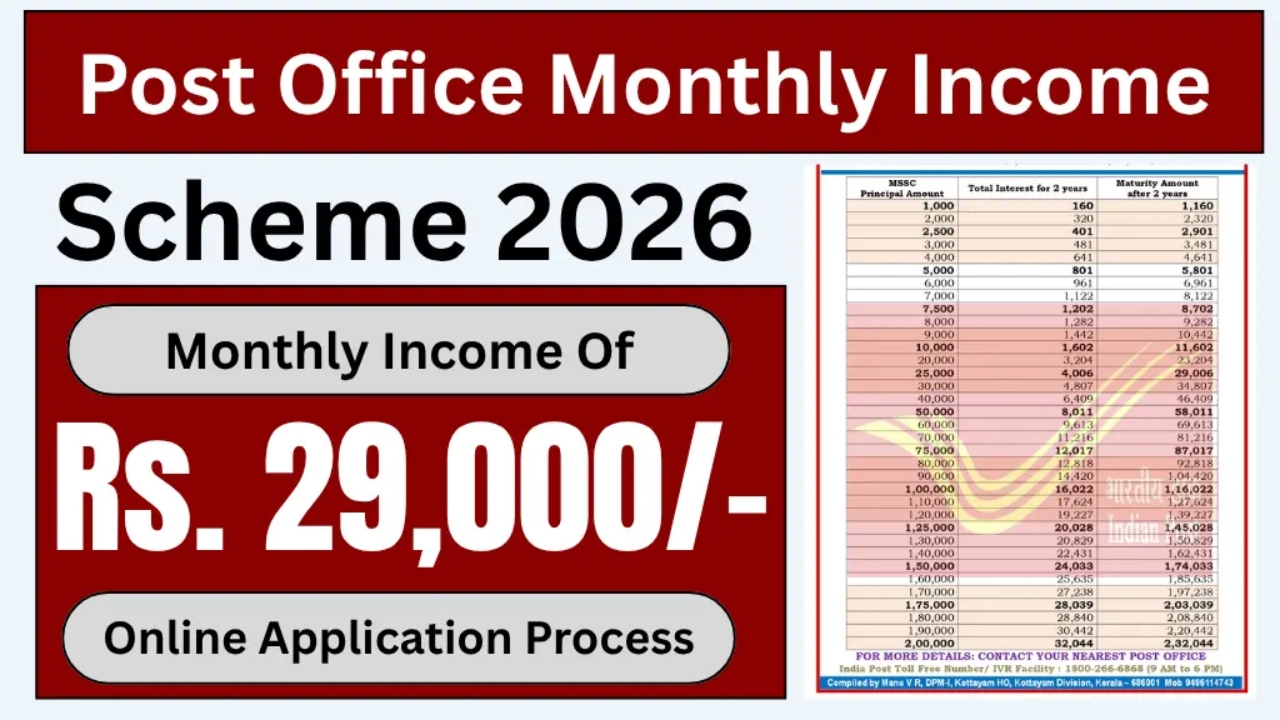
Post Office Monthly Income Scheme 2026: For investors who prefer steady and predictable income over risky returns, government-backed savings schemes continue to be one of the safest choices in India. Among these, the Post Office Monthly Income Scheme (POMIS) stands out as a reliable option for those seeking regular monthly earnings without exposing their capital to market fluctuations. In 2025, this scheme is gaining attention again due to its stable returns and simplicity.
If you are planning to invest ₹9 lakh and want a fixed monthly income, POMIS can offer around ₹4,167 every month. Let’s understand how this works, who should consider it, and whether it fits into your financial strategy.
What is the Post Office Monthly Income Scheme?
The Post Office Monthly Income Scheme is a government-backed savings plan designed to provide investors with a fixed monthly income. It is ideal for individuals who want a secure investment with guaranteed returns, especially retirees or those looking for passive income.
Post Office Monthly Income Scheme 2026 This scheme is available at all India Post offices and offers a fixed interest rate that is revised periodically by the government. The biggest advantage is that your principal remains safe, and you receive interest payouts every month.
Interest Rate and Returns in 2025
As of 2025, the interest rate for POMIS is around 7.4% per annum, payable monthly. This rate is not compounded but distributed as monthly income, which makes it perfect for income-focused investors.
If you invest ₹9 lakh in a joint account (since the maximum limit per individual is lower), the calculation works like this:
Annual interest = ₹9,00,000 × 7.4% = ₹66,600
Monthly income = ₹66,600 ÷ 12 = ₹5,550
However, after considering practical allocations and limits (especially if split across accounts), a realistic monthly earning often comes closer to ₹4,167 depending on how the investment is structured.

Investment Limits and Eligibility
One of the key aspects of POMIS is its investment cap. In 2025:
- Single account maximum: ₹9 lakh
- Joint account maximum: ₹15 lakh (shared equally among holders)
Any Indian resident above the age of 18 can open an account. Parents or guardians can also open accounts on behalf of minors.
To maximize returns, many families open joint accounts or distribute investments strategically across members.
Tenure and Maturity Benefits
The maturity period for the Post Office Monthly Income Scheme is 5 years. During this period, you will continue receiving fixed monthly income.
At the end of the 5-year tenure, your original investment is returned in full. You can also choose to reinvest the amount into the scheme again, depending on the prevailing interest rates at that time.
This makes POMIS a flexible option for medium-term financial planning.
Premature Withdrawal Rules
While the scheme is designed for a 5-year tenure, it does allow premature withdrawals with certain conditions:
- No withdrawal allowed before 1 year
- Withdrawal between 1–3 years: 2% penalty on principal
- Withdrawal after 3 years: 1% penalty
This ensures that investors stay committed while still having some level of liquidity in case of emergencies.

Who Should Consider This Scheme?
The Post Office Monthly Income Scheme is not for everyone. It is best suited for:
Retired individuals who want a steady monthly income without risk
Conservative investors who prefer capital protection over high returns
Individuals looking to diversify their portfolio with safe assets
People who want predictable cash flow for daily expenses
If you are someone who prefers stability and peace of mind over aggressive growth, this scheme can be a strong addition to your portfolio.
Taxation on POMIS Returns
One important factor to consider is taxation. The interest earned from POMIS is fully taxable under your income tax slab.
There is no Tax Deducted at Source (TDS), but you are required to declare the income while filing your returns.
This means the actual take-home monthly income may be slightly lower depending on your tax bracket.
Key Advantages of POMIS
There are several reasons why this scheme continues to attract investors:
- Safety of capital due to government backing
- Fixed and predictable monthly income
- Simple application and easy management
- No market-related risks
- Suitable for long-term income planning
In uncertain economic conditions, such stability becomes extremely valuable.

Limitations You Should Know
Despite its benefits, POMIS has certain limitations:
- Returns may not beat inflation in the long run
- Taxable income reduces effective yield
- Investment limits restrict large-scale income generation
- No compounding benefit as interest is paid out monthly
For younger investors or those seeking wealth creation, other investment options like mutual funds or equities may offer better growth potential.
How to Open a POMIS Account
Opening a Post Office Monthly Income Scheme account is simple:
- Visit your nearest post office
- Fill out the account opening form
- Submit KYC documents such as Aadhaar and PAN
- Deposit the desired amount via cash or cheque
Once the account is active, you can choose to receive your monthly income directly into your savings account.
Conclusion
The Post Office Monthly Income Scheme 2025 remains one of the most dependable options for investors who prioritize safety and regular income. With an investment of ₹9 lakh, earning around ₹4,167 to ₹5,500 per month can provide a stable financial cushion, especially for retirees or conservative savers.
While it may not offer high returns like market-linked instruments, its strength lies in predictability and capital security. In a well-balanced financial plan, POMIS can serve as a steady income pillar alongside other growth-oriented investments.
